Results from Our Partner Network: Karcag’s Example in Air Quality Protection – Strategy and Innovation
Improving air quality in Hungary is not solely the responsibility of large cities. Karcag’s example demonstrates that strategic thinking and long-term commitment can enable a medium-sized municipality to play a significant role in environmental protection programmes.
Within the LIFE IP HungAIRy project, the Municipality of Karcag holds a unique position. Throughout the eight-year programme, it is the only participating municipality that does not have county-level city status. This distinction is not only a source of pride but also a strong professional recognition of the town’s longstanding environmental efforts.
Eight Years, Twenty-Four Actions for Cleaner Air
The project is far more than a short-term campaign. It is a comprehensive development process running until the end of 2026. As part of its commitment, the Municipality of Karcag has undertaken to participate in a total of 24 different actions during the eight-year implementation period.
These measures cover nearly every aspect of air quality protection, ranging from public awareness-raising activities to infrastructure development.
One of the programme’s most important pillars is the establishment and operation of the local eco-manager network. Acting as a bridge between the municipality and residents, eco-managers support the modernisation of household heating systems through awareness-raising campaigns, provide information on available funding opportunities, and promote sustainable modes of transport.
Maintaining good air quality requires continuous assessment and planning. Karcag actively contributes to the regular revision of air quality action plans, which are updated every two years in cooperation with the Jász-Nagykun-Szolnok County Government Office.
Strategy and Awareness-Raising: The Air Quality Demonstration House
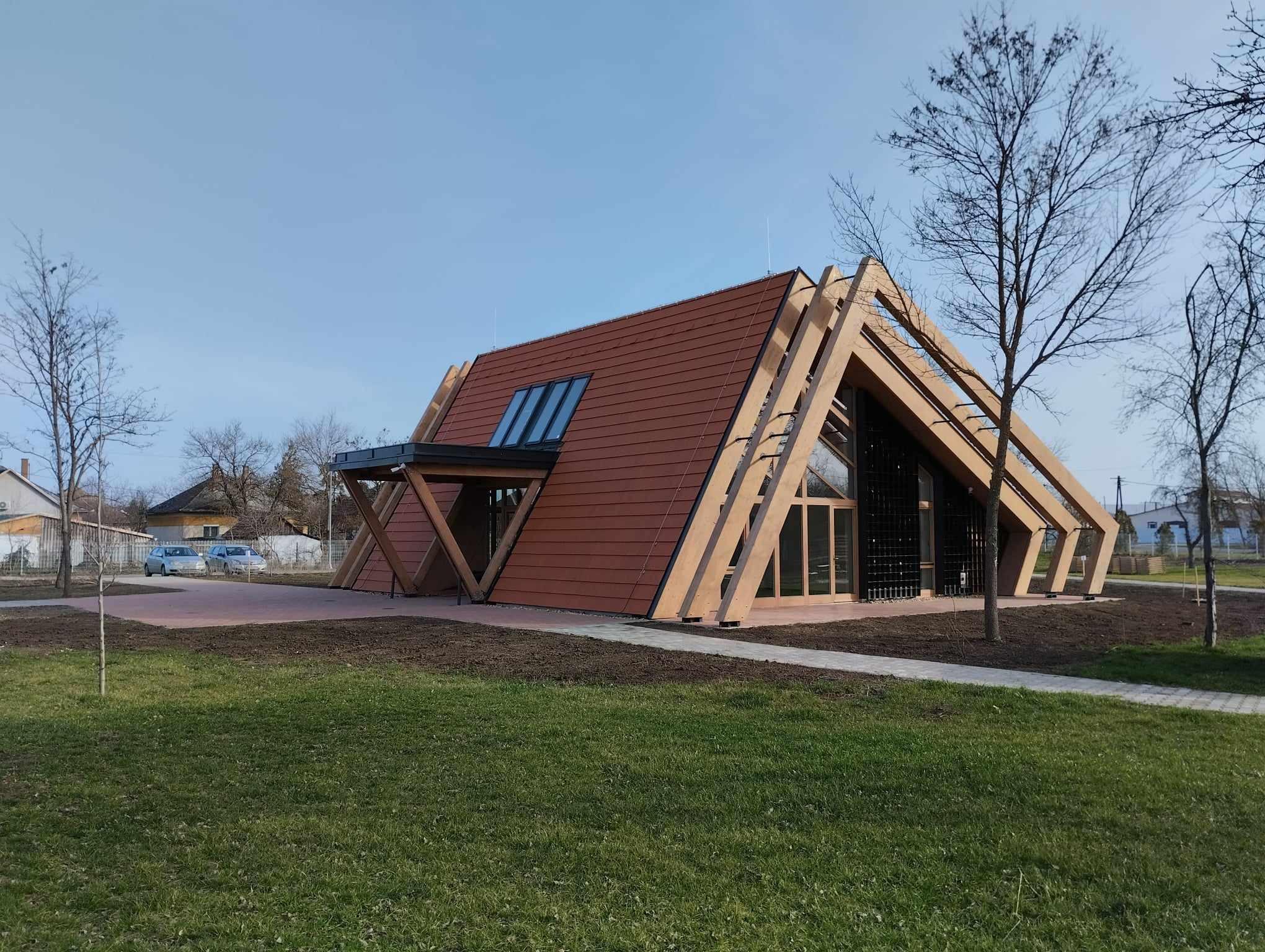
One of the most visible and innovative achievements of the project has undoubtedly been the establishment of the Air Quality Demonstration House. More than an information centre, the building serves as an interactive community space where visitors can:
- learn about environmentally friendly heating practices through hands-on experiences;
- receive expert guidance on energy-efficiency investments;
- take part in interactive environmental education activities designed for younger generations.
The Demonstration House was officially opened on 16 May 2024 and has since welcomed dozens of school groups and hundreds of students.
Designed with energy efficiency in mind, the building is equipped with 14 solar panels. Under favourable weather conditions, these panels are capable of covering the entire energy demand of the facility. The roof is oriented towards the south and has a 30-degree pitch, ensuring optimal annual energy production.
Two sides of the building feature pergola extensions that provide passive protection against solar heat gain on the glazed surfaces. In addition, motorised external shading systems installed on both sides help regulate indoor temperatures. Under optimal conditions, the use of shading alone can reduce indoor summer temperatures by up to 3°C.
Heating and cooling are provided by a 12 kW air-to-water heat pump system, which would also be capable of meeting the heating demand of a detached family house of approximately 120–150 square metres. The system operates using environmentally friendly refrigerants.
A central heat recovery ventilation system ensures proper air exchange by removing stale indoor air and supplying filtered, fresh air at a comfortable temperature. The building’s climate-control and fan-coil systems operate with water rather than refrigerant gases, providing an additional environmental benefit.
The 167-square-metre facility includes an exhibition area, an educational lecture room for awareness-raising activities, and the Eco-Manager Office.
HungAIRy eco-managers in Karcag continue to welcome visitors, school classes and community groups throughout 2026 and beyond, offering practical, hands-on insights into energy-efficient building operation and the other awareness-raising focus areas of the LIFE project.


