Results from Our Partner Network: Real-Time PM Monitoring and Data-Driven Air Quality Analysis in Two Hungarian Cities
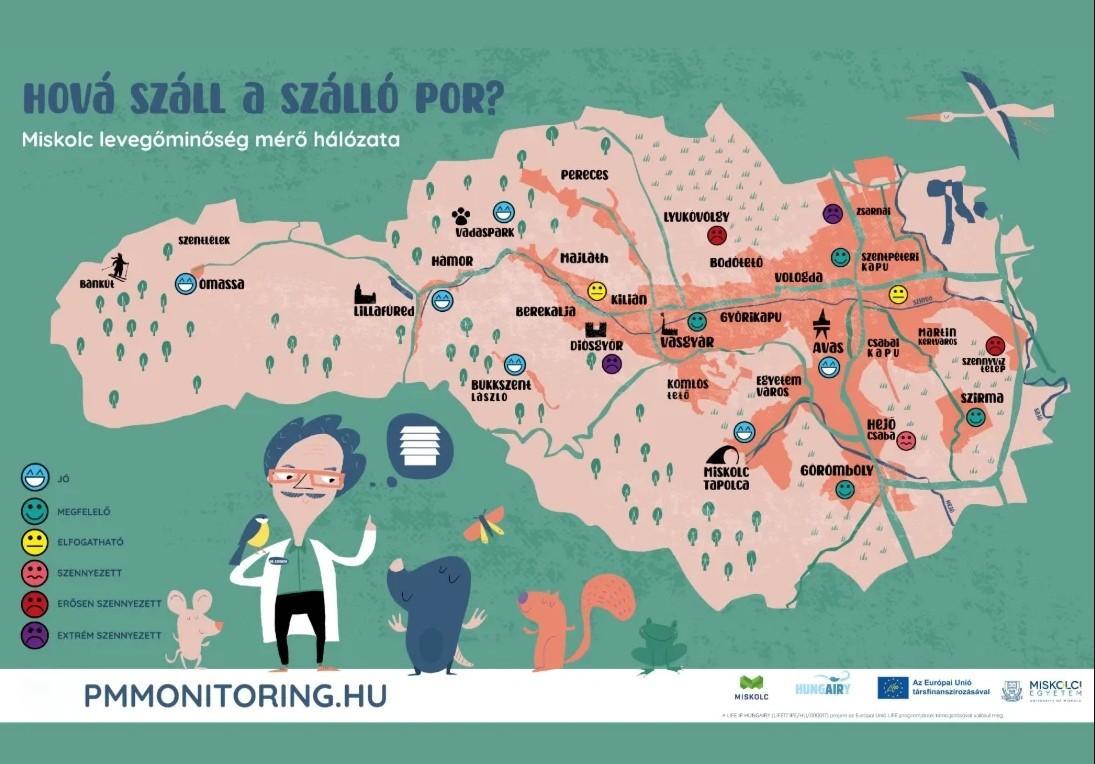
Today, a few monitoring stations alone are no longer sufficient to gain a precise understanding of air quality. There is an increasing need for detailed, real-time information. The PM monitoring network established by the University of Miskolc and its municipal partners provides an innovative solution to this challenge, taking air quality assessment in both Miskolc and Kaposvár to a new level.
The system not only represents progress for experts but also makes data directly accessible to residents, strengthening environmental awareness and helping local communities better understand air quality processes.
Two Cities, One System
The particulate matter monitoring network was launched in Miskolc in September 2021, followed by the installation of the system in Kaposvár in November 2021. Data from the 60 measuring units operating in Miskolc and the 20 units installed in Kaposvár are available to anyone in real time through an online platform. Since November 2024, the network has been further expanded, with measurements now also being carried out in settlements surrounding Miskolc.
After nearly five years of operation, the PM monitoring system enables local air quality characteristics to be analysed in greater detail than ever before. Thanks to the dense coverage of the network, it is possible not only to track current conditions but also to examine the formation, spread and movement patterns of particulate matter pollution.
Local Processes and Urban Patterns
One of the most important findings of the measurements is that both Miskolc and Kaposvár frequently experience significant differences in air quality conditions within the same city. While certain urban areas may show particularly high pollution levels, other parts of the city can record considerably more favourable values.
These observations contribute to a deeper understanding of local processes and help identify the factors influencing changes in air quality. The monitoring network therefore does not simply provide data, but also reveals meaningful patterns that can be interpreted and analysed.
Reliable Data and Continuous Verification
The measuring units installed in the network monitor PM10 and PM2.5 concentrations, as well as temperature and humidity levels. The collected data are transmitted in real time to a central database, where they are displayed and further processed.
It is important to highlight that all applied low-cost sensors undergo calibration, and selected measuring units are continuously compared with data from the official National Air Pollution Measurement Network (OLM – Országos Légszennyezettségi Mérőhálózat). This provides an objective assessment of the system’s performance and reliability.
Public Access and Awareness-Raising
The monitoring network also plays an important role in raising public awareness. Thanks to the online platform and related communication activities, more than 20,000 active users follow the measurements, while the number of visits has reached 600,000.
Through presentations, events and other outreach activities, interested residents can continuously access up-to-date information, contributing to greater awareness of air quality issues.
Developments and Future Directions
Operating and maintaining the system is an ongoing task, including the periodic replacement of sensors and further development of the network. The experience gained over recent years provides a stable foundation for future expansion.
In the coming years, artificial intelligence-based data mining research will play an increasingly important role. The objectives include improving sensor accuracy through machine learning methods and developing a new AI-supported analytical platform that can provide even deeper insights into air quality processes.


